DeepTech perspectives on perception, reasoning, and resilience
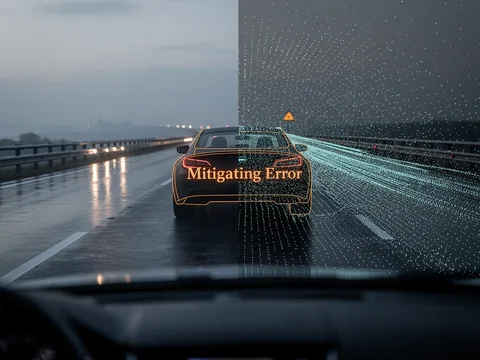
Runtime Monitoring for SOTIF: A Monitor Ensemble for AI-Based Perception
A new peer-reviewed, open-access paper in Discover Artificial Intelligence (Springer Nature) sets out a runtime monitor ensemble that supervises AI-based perception during operation, giving a defensible basis for the safe release and series operation of autonomous driving functions under SOTIF.
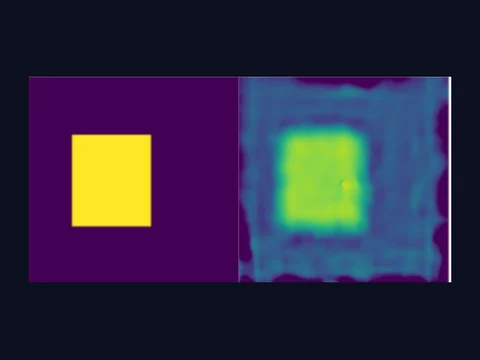
The Affine Ceiling: Sharp on Affine Motion, Blind at Depth
Formal motion estimation is dismissed as good only for small motion. A benchmark against pixel-exact ground truth shows that is false: large scaling and rotation are solved to sub-pixel accuracy. The real ceiling is the affine assumption, and it collapses at exactly the depth boundary that 3D reconstruction is made of.

Your Perception Stack Is a Snapshot Machine
Most perception stacks reason one frame at a time. The network detects, tracking is bolted on afterwards, and the system never really carries the world forward. A snapshot machine cannot validate cleanly, because the thing that would make its output trustworthy is the thing it discards between frames: continuity.
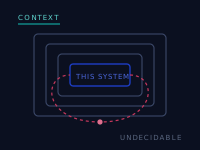
Gödel Is Not a Death Sentence for Reason
Gödel's incompleteness theorem, Hume's induction problem, the halting problem, and AI hallucination are not isolated failures of reason. They point to the same missing term: context.
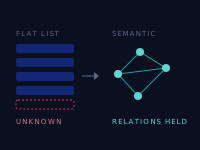
Why Autonomous Perception Needs More Than Flat Object Lists
Most ADAS perception stacks classify what they already know. The real world is combinatorial, contextual, and full of unknowns. Semantic fallback systems are needed when flat object lists fail.

We Have Been Here Before
Computing was once centralized in the server rooms of banks, universities, and large corporations, until two people in a garage changed the game. With AI we have returned to a cloud-centric architecture. Is the same thing about to happen again, 52 years later?

AI Strategy Should Not Begin With Tools
AI strategy should begin with maturity, feasibility, risk, and governance, not tools. An overview of the FelixSchallerCOM advisory services for AI strategy, safety, and technical due diligence.

The EU AI Act Is Not a Legal Problem. It Is a Technical One.
Most organisations are approaching the EU AI Act as a compliance checklist. That is the wrong starting point. Genuine conformity requires technical governance infrastructure that most AI environments do not yet have.
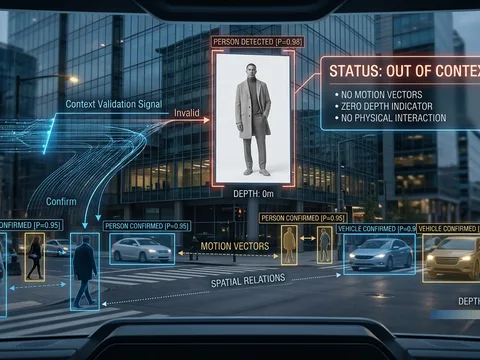
Autonomy Is Underestimated Because Governance Is Missing
Autonomy built on probabilistic systems needs supervision, guardrails, and governance until AI can verify its own outputs.
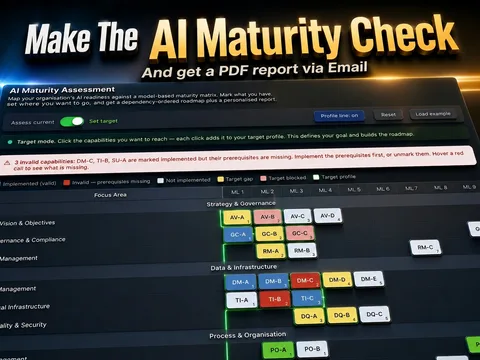
Why Most Enterprises Get Enterprise AI Wrong, And How to Fix It
Most enterprises harness AI by its tail. A formal maturity model is the only way to build a coherent, governable AI stack, before the mess becomes unmanageable.
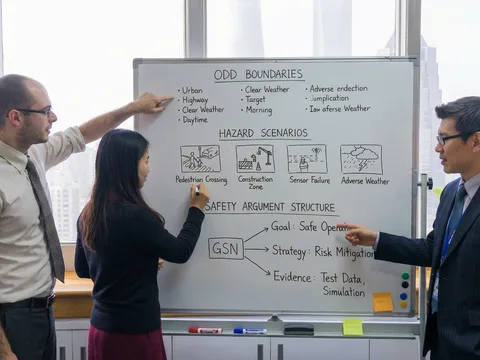
Why True Autonomous Driving Requires More Than Perception
Most autonomous systems are sophisticated snapshot machines. They perceive the world in the moment, and then forget it. That is not how safe autonomy works.

Autonomous Flight Is a Solved Problem. Autonomous Driving Is Not.
The difference is not engineering effort. It is geometry, physics, and the dimensionality of the operating environment.

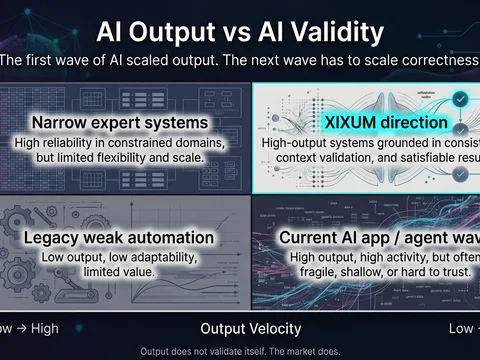
We Are Shipping More AI Than Ever. That Does Not Mean We Are Creating More Value.
AI app launches are accelerating. Usage is not keeping up. The bottleneck has shifted from generation to validation, and that is exactly where XIXUM is built.
The Shampoo Bottle Paradox: Why More Data Cannot Close the AI Autonomy Gap
You cannot solve an undecidability problem by scaling quantity. Decidability is bounded by the informational resolution of the observer.

From Desalination Dependency to Water Resilience Architecture
Gulf water security is not a desalination-capacity problem. It is a resilience architecture problem.

Why GraphRAG Is Not Enough for Real Reasoning
GraphRAG solves a retrieval problem. It does not solve a reasoning problem. These systems do not build knowledge, they build approximations.

Why LLMs Are Fundamentally Problematic in Safety-Critical Systems
Large Language Models are powerful tools for text generation, but they introduce structural risks when used in safety-critical or regulated environments.
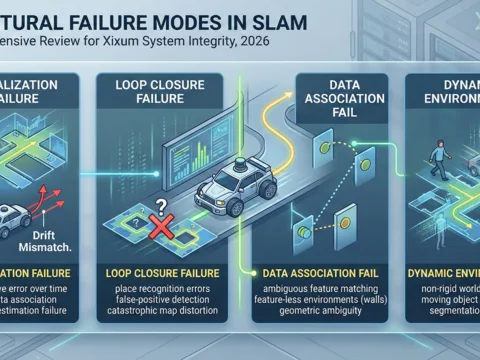
SLAM Is Not Solved. It Is Just Benchmark-Optimized.
SLAM is benchmark-optimized, not solved. Feature tracking breaks down on repetitive surfaces, and neural depth estimation replaces geometric ambiguity with opacity. Until localization stacks treat context as a first-class structural concern, safety-critical autonomy remains fundamentally fragile.