Runtime Monitoring for SOTIF: A Monitor Ensemble for AI-Based Perception
A new peer-reviewed, open-access paper in Discover Artificial Intelligence (Springer Nature) sets out a runtime monitor ensemble that supervises AI-based perception during operation, giving a defensible basis for the safe release and series operation of autonomous driving functions under SOTIF.
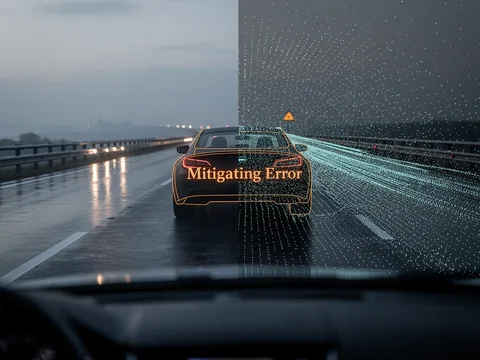
Our paper "Addressing SOTIF with a Runtime Monitor Ensemble for AI-Based Perception Systems" is now published, open access and peer-reviewed, in Discover Artificial Intelligence (Springer Nature). The free full text is available through the SharedIt link at the end of this post, and the article of record sits at doi.org/10.1007/s44163-026-02186-z.
Why perception is the hard part of SOTIF
Functional safety has a mature answer for systematic faults and for random hardware failures. AI-based perception fits neither box cleanly. A perception model is trained on a finite slice of the world and then asked to operate in an open one, where the objects, the weather, the lighting and the road users are not fully specified in advance. ISO 21448, SOTIF, is precisely about this: the safety of the intended function under triggering conditions that the specification and the training data never enumerated.
The uncomfortable part is that you cannot test your way out of it offline. However large the validation set, the open world will present inputs it did not contain, and a model that looked well behaved in the lab can produce a confident wrong output in the field. Release readiness therefore needs a second question alongside "did it pass validation": can the perception output be trusted at this moment, during operation, on inputs no one has seen before.
The idea: an ensemble of monitors, not a single check
The paper answers that with a runtime monitor ensemble. Rather than trusting one supervising check, a set of complementary monitors observes the perception output while the system runs and combines into a safety verdict. Different monitors catch different failure modes, so the ensemble degrades gracefully where any single monitor would have a blind spot. The result is a signal the surrounding safety architecture can act on: it surfaces near-misses, flags when perception should not be trusted, and gives a defensible, evidence-backed basis for both safe release and reliable series operation of autonomous driving functions.
Where the work comes from
The paper is an outcome of SafeWahr, a BMWK-funded joint research project on the safe release of AI-based systems. The consortium was coordinated by AVL, with partners including Intel, Deep Safety, TU Clausthal (Institute for Software and Systems Engineering), STTech and Validas, where the runtime-monitoring work package sat. It is joint work with co-authors across the consortium, in particular Rüdiger Ehlers and Andreas Rausch at TU Clausthal.
What this means for teams releasing autonomy
If you are moving AI-based perception toward a release, the runtime layer is where the SOTIF argument is won or lost. Offline metrics tell you how the model behaved on data you already had. A monitoring layer tells you how much to trust it on the data you are seeing now, which is what an assessor, and the field, will actually test. Building that layer, and the safety case around it, is a large part of the safe-release work I do.
If that is on your roadmap and you want the SOTIF and safe-release approach to hold up under audit, a short expert call is a good place to start.
Read the paper (free full text)
Citation: Schaller, F., Ehlers, R., Aslam, I. et al. Addressing SOTIF with a runtime monitor ensemble for AI-based perception systems. Discover Artificial Intelligence (2026). doi.org/10.1007/s44163-026-02186-z