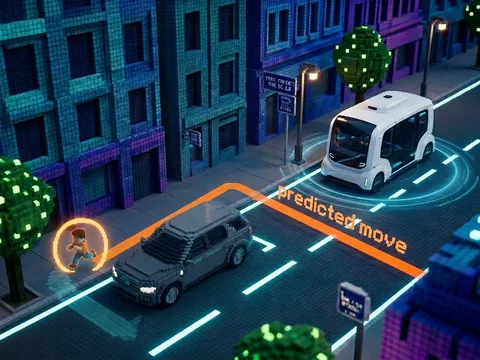
Hierarchical Perception
Flat object lists drop what they have not seen before. This demo abstracts each detection up a semantic taxonomy to the most specific level it can safely justify, and cross-checks it with an independent segmentation path.
A flat object list is a closed world. Anything outside its fixed set of classes becomes a blank, and a blank on the road is a safety problem: the object is still there, the system just has no word for it. This demo shows a perception design that does not drop what it has not seen before.
Two independent paths
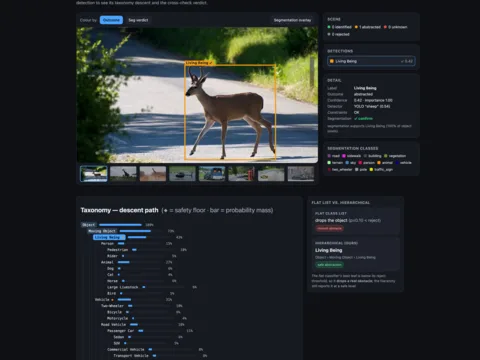
Instead of forcing a single label, every detection is abstracted up a semantic taxonomy to the most specific level the system can safely justify. A clear pedestrian stays a pedestrian; an unfamiliar object still lands at, say, "dynamic obstacle" rather than nothing. The novel object is not lost, it is placed as precisely as the evidence allows.
A second, independent segmentation path then cross-checks that verdict. Two paths that can disagree are worth far more than one confident classifier, because the disagreement is exactly where the risk lives.
What you can do
Pick a scene, toggle the segmentation overlay, and click any detection to watch its descent down the taxonomy and read the cross-check verdict. A flat-list view sits next to the hierarchical one, so the difference is visible rather than argued.
Beyond the closed set
A closed detector can only draw a box around a class it was trained on, so a genuinely unfamiliar object may get no box at all. An open-world extension adds class-agnostic proposals, which surface a region wherever something object-like appears, and hands each one to the same taxonomic classifier. An out-of-vocabulary object therefore still lands at a safe coarse category or an explicit UNKNOWN OBSTACLE, rather than being missed because it never had a label to begin with. This is the step from recognizing known classes more safely to handling classes the system was never taught.
The basis
The demo is the reference implementation of the taxonomic abstraction line of work: F. Schaller, "Open-World Hierarchical Perception: Taxonomic Abstraction over Class-Agnostic Proposals for the Safe Handling of Out-of-Vocabulary Road Objects" (arXiv:2608.07577, 2026), the open-world extension of "Hierarchical Taxonomic Abstraction for the Safe Handling of Novel Objects in Autonomous Driving Perception" (Zenodo, 2026, doi:10.5281/zenodo.21593472), which builds in turn on "The Role of Semantic Models in Constraining Pattern Recognition" (Intelligent Environments 2025, doi:10.3233/AISE250023). Detections are computed offline with YOLOv8, CLIP, and CLIPSeg; the page itself is fully static.
The open-world model is published as HOWC, with a public, runnable model card on Hugging Face: huggingface.co/freshNfunky/howc. The full source is open on GitHub: github.com/freshNfunky/IE2025-Research-Paper.
This is the working demonstration of the argument in Why autonomous perception needs more than flat object lists.