3D Interactive Perception Gap
Does your perception carry physics forward, or judge each frame alone? Pick a scenario, toggle a per-frame stack against a continuity-gated world model, and watch whether the road user stays tracked through occlusion. Then see where your stack lands and get an evidence-gap report.
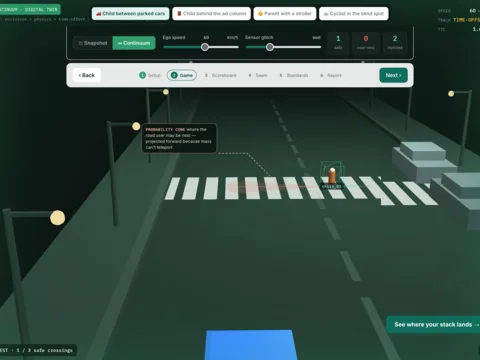
A per-frame perception stack answers one question: what does this frame support? A safety case asks a harder one: does the interpretation hold across time and across physics? This tool lets you feel the difference by driving it, not by reading about it.
What you can do
Pick a scenario, a child between parked cars, a child behind an ad column, a parent with a stroller, a cyclist in the blind spot, set the ego speed and a sensor glitch, then toggle between a snapshot stack and a continuity-gated world model and watch the same moment play out. The continuity model carries the dashed predicted box through the occlusion, so the track stays on the child even while the camera cannot see them. The snapshot stack lets them vanish, and the brake comes too late.
The four probes
The sixty-second tour walks the chain that decides a release:
- Continuity. Does a reading from a moment ago still exist when the sensor misses it for a frame?
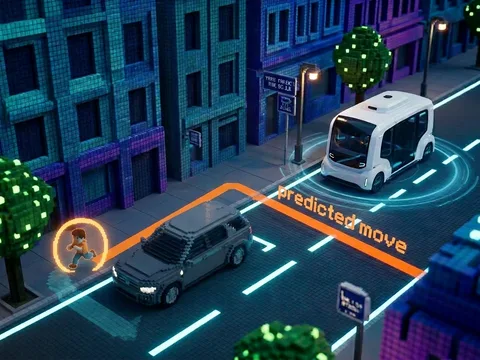
- Prediction. A co-simulated digital twin projects motion forward, because mass cannot teleport, into an optimal track and a widening probability cone. That foresight is the braking margin a snapshot never has.
- Physics gate. A detection that violates inertia, occlusion, or geometry is treated as an error, not a detection. The phantom is gated instead of triggering a phantom brake.
- Traceability. Evidence usually exists on both sides. What decides the release is the spine connecting a known failure mode to a safety goal, and that seam is where most stacks are thin.
At the end you see where your described stack lands, with the open seam named and an evidence-gap report you can have by email.
The basis
This is the interactive companion to the essay Your Perception Stack Is a Snapshot Machine, also published on Medium, and to the offline research build Digital Twin Perception, which carries the same continuity and physics argument into a persistent 3D driving context.