UAV Airspace Digital Twin
The driving digital twin, re-aimed at the sky. A Doppler-radar detect-and-avoid safety-cage flies beside a BVLOS courier, tracks every intruder, forecasts the closest point of approach, and re-plans by the rules of the air before a conflict arrives. Fully client-side, flown in the browser.
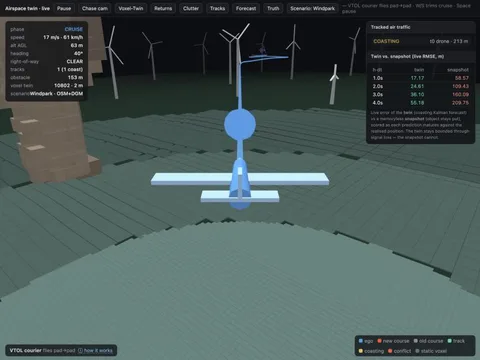
A planned drone route is the easy part. The hard part is everything else moving in the air near it. This tool takes the continuity-and-physics idea behind the driving digital twin and re-aims it at low-level BVLOS airspace: a Doppler-radar detect-and-avoid safety-cage that runs beside a self-flying courier, tracks every intruder, forecasts the closest point of approach, and re-plans by the rules of the air before a conflict arrives. It is fully client-side, so you fly it yourself in the browser, with no backend and no install.
What you can do
Watch a BVLOS courier fly a looping route by itself while intruders, a crossing drone, a descending bird, a helicopter transit, fly their own tracks. The twin rebuilds the static world as an adaptive voxel octree, finds the movers with radar, and colors the course as it re-plans: grey to red when a conflict is fresh, back to blue once it settles. Drag to orbit, scroll to zoom, switch scenarios. A live panel scores the twin's coasting forecast against a memoryless snapshot, so you can watch the snapshot diverge while the twin stays bounded through signal loss.
How the twin reads the sky
- Doppler, not LiDAR. Radial velocity is measured per return, directly, which holds up in rain, fog and dust and is exactly the detect-and-avoid radar a SORA authorization is built around.
- Persistent tracks that coast. Intruders are tracked in 3D, constant velocity and Doppler-fused. On signal loss a track dead-reckons and its uncertainty cone widens, until a fresh return re-acquires and snaps it back.
- Newtonian plausibility veto. Every return is cleared against inertia and geometry before it may update a track, so a teleporting clutter point or a physics-violating jump is an error, not a detection. A spinning turbine is held as obstacle geometry yet told apart from a free flyer by its micro-Doppler signature, so a rotor disc never becomes a phantom intruder.
- CPA conflict and air-law routing. Each track is forecast with its cone and run through closest-point-of-approach against the ego. The autopilot gives way or stands on by the rules of the air, turning, climbing or diving under a crossing track to maximize the miss distance, so two aircraft never oscillate.
The basis
This is the airspace sibling of the road-focused research build Digital Twin Perception, and it shares the thesis of Your Perception Stack Is a Snapshot Machine: perception is a world model that persists and accumulates evidence over time, not a stream of independent snapshots. Here that argument is re-aimed from the road to the sky.
It is a research rig on a synthetic scenario, built on public data, real DGM terrain and OpenStreetMap obstacles, and on public standards. It is not a product and not a certified detect-and-avoid system.