Services / SVC / SLAM
SLAM Structural Robustness Reviews
Where localization degrades before it fails loudly.
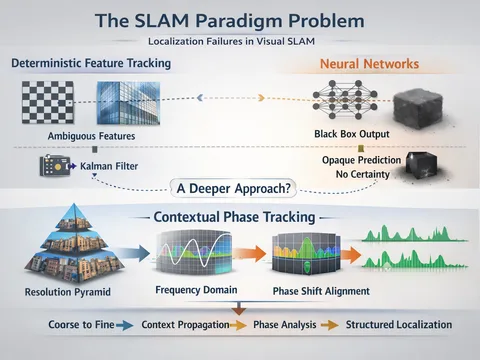
Modern SLAM systems are often optimized for accuracy benchmarks, but rarely evaluated for structural robustness under real-world and certification constraints.
Bridging engineering architecture with ISO 26262 and SOTIF requirements, before redesign becomes expensive.
This review focuses on pose graph stability, drift accumulation patterns, feature ambiguity in repetitive environments, sensor degradation scenarios, failure transparency under SOTIF, and traceability requirements under ISO 26262. The goal is not incremental tuning. It is architectural clarity.
Scope of a structural robustness review
- Observability analysis. Evaluation of state variables under partial sensor degradation and dynamic environments.
- Feature ambiguity risk. Assessment of repetitive pattern instability and graph inconsistency behavior.
- Sensor fusion stability. Analysis of IMU drift, LiDAR occlusion, timestamp misalignment, and calibration sensitivity.
- Implicit model risk. Review of neural depth or motion estimation components for safety transparency gaps.
- ODD boundary stress testing. Identification of degradation behavior outside nominal operational design domains.
- Certification gap mapping. Comparison of architecture against ISO 26262 and SOTIF audit expectations.
How we work
- Architecture mapping. Breakdown of perception, localization, mapping, and integration layers.
- Assumption extraction. Explicit documentation of environmental and motion assumptions.
- Instability identification. Identification of hidden coupling effects and drift amplification patterns.
- Certification alignment. Evaluation of evidence generation feasibility and traceability structure.