Humanoid Autonomy Compass
A humanoid robot on a shared floor needs different controls than an agent drafting copy. Derive the fitting oversight regime from three properties you can actually check, then turn that verdict into a compliance checklist you can export.

The question is not whether a system is autonomous. It is how long it is allowed to act before a human sees the result, and what is left broken if it gets that stretch wrong.
The compass derives an oversight regime from three properties you can check without a workshop:
- Run time. How long it acts unsupervised in one stretch, from a single reviewed step up to continuous operation across days.
- Environment. How predictable the context is that it decides in, from stable to unpredictable.
- Reach. What can break in the worst case, from read-only through changing state and moving physically to being able to injure people.
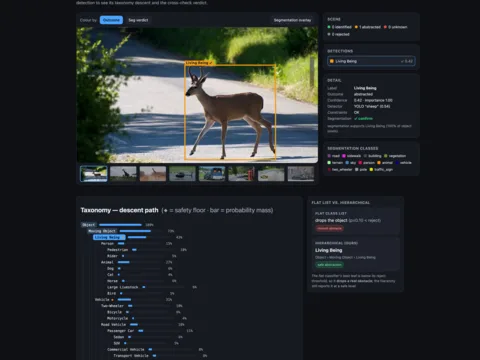
From those it places the deployment on a continuous risk field and names two classes: the autonomy window A, and the oversight regime K, from every action approved in advance by a named person, through monitoring with the ability to intervene, down to after-the-fact review of logs. It recommends the loosest regime that still stays inside the tolerance your risk load allows. If even the tightest regime exceeds it, the tool says so plainly: not defensible as configured, shorten the run time or narrow the reach.
The whole derivation is on screen. Weightings, tolerance bands and the control mapping are a reasoned engineering choice, not a normative text, and they sit in the source where you can argue with them.
The second half is the part that usually gets deferred. The verdict turns into a concrete checklist of exactly the controls your profile triggers, each mapped to its clause in NIST AI RMF 1.0, the EU AI Act high-risk obligations, ISO/IEC 42001, the machinery and robot safety standards for anything that moves, and SAE J3016 as the analogy for graded autonomy. Set a status per control, attach evidence, watch the readiness score and the gap count move, then export the result as JSON or as a report.
It is an indicative mapping and an orientation aid for internal discussion. It is not a certification, not legal advice, and it replaces neither a safety assessment nor a review of your specific case. It is the conversation you should have before go-live, not the record that you had it.