Perception Safety Evidence Gap Check
Seven questions along the perception-to-release chain reveal where the evidence trail from your perception stack's failure modes to the safety goal is missing, without requiring ground truth.
Description
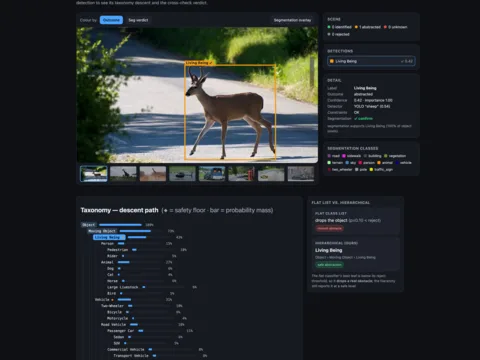
The check walks through seven probes along the chain of an ML-based perception stack: measurement basis without ground truth, triggering conditions, monitor quality, cross-modal consistency, persistence as a validation signal, traceability, and the organizational seam between the perception and safety teams. Each answer carries an evidence weight, and the chain turns red wherever the proof is missing. The result names your largest open point and the next defensible step.
Scope and limits
The check does not judge the safety or conformity of a system and does not replace a safety case. It surfaces open evidence points. Tool, library, and compiler qualification per ISO 26262-8 is deliberately out of scope and is flagged as a separate evidence strand. Inputs are abstract multiple choice only. No free-text field invites confidential function details.